★★★★★
fast service- they sent the team after 3 hours of my call to them- and with the next day curtians were installed-
Nelson Gray
September 2026

Four catalogues, all held in our own UAE warehouse. Because the roll is already here rather than on a ship, we quote days rather than weeks. Our team brings the physical books to your home so you judge the colour in your own light.
Three of these are blackout and one is sheer, and that is the first decision rather than the colour. A blackout stops the light and most of the heat that comes with it. A sheer softens the glare and gives daytime privacy while keeping the room bright. Most homes here end up with both, on a double track, because a single blackout forces a choice between full sun and full darkness with nothing in between.
Among the blackouts, the difference is surface rather than performance — all three exclude light equally. 301 has a visible texture that hides creases and suits large windows. 302 is a flat plain weave that recedes into a wall, which is why it dominates in bedrooms. 303 is jacquard, with the pattern woven in rather than printed, and it is the only book with genuine colour in it.
401 is the chiffon sheer, in a plain series and a finer textured “TTL Sable” series.
Every shade within a book costs the same, so the choice is purely about how you want the room to look and feel. Colour is also the one thing that does not survive a screen: fabric backlit by the sky behaves differently from fabric backlit by a monitor, which is why the visit exists.
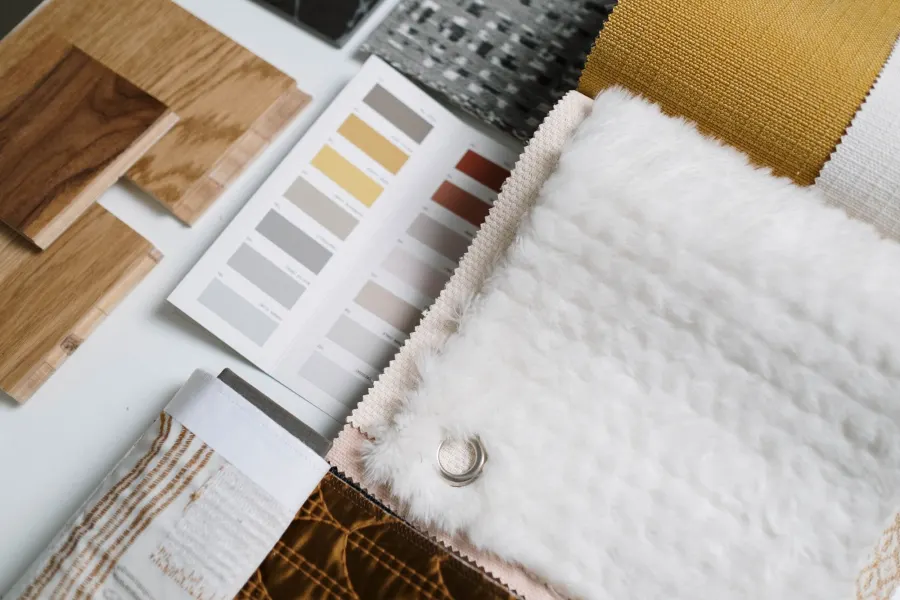
Switch between the books and tap any shade to drape it. The panels are the cloth itself, photographed from the catalogues in our warehouse — so what changes is the real weave and colour, not a tint over a drawing.
Our curtain fabric catalogue in Dubai runs to four books and 76 shades, and the useful comparison is not colour but construction. The curtain material types we hold are textured blackout, plain blackout, jacquard blackout and chiffon sheer — three that stop light and one that softens it. The blackout fabric versus sheer fabric decision is really a decision about when you want the room dark: a blackout gives you sun or darkness, a sheer keeps the room bright while stopping people seeing in, and most homes end up with both on a double track. Curtain fabric samples in Dubai are best judged in the room they will hang in, because warm afternoon light pushes neutrals yellow and a north-facing room pulls the same shade grey — which is why the books come to the home rather than the other way round.
A fabric book tells you the colour and very little else. What separates one blackout from another is weight, weave and how the cloth behaves when it hangs — none of which photographs, and two of which you can check yourself in a few seconds with a sample in your hand.
Fabric weight is quoted in grams per square metre. A heavier cloth hangs with deeper, more regular folds and is more forgiving of an imperfect drop; a lighter one moves more and creases more readily. Weave matters as much: a triple weave builds the light-stopping layer into the cloth rather than coating the back, which is why the fabric still feels like fabric and why a pale shade can be a genuine blackout. A coated blackout, by contrast, tends to feel stiff, and the coating is the part that fails first.
Two things worth doing with any sample. Hold it up against a bright window: that is your real light test, and it will tell you more than a label. Then bunch it in your hand and let it fall — that is roughly what it will do when gathered at 2.0x or 2.5x fullness, and it is the quickest guide to whether a fabric will drape or stand.
Fabric backlit by the sky behaves differently from fabric backlit by a monitor, and the light in a Gulf apartment is not the light a photograph was taken in. Warm sunlight pushes neutrals towards yellow; the cool light of a north-facing room pulls the same shade grey. This is the single reason we bring the books to the home rather than asking anyone to choose from a screen. If you are narrowing down, look at a shade against the wall it will hang beside and at the time of day you use the room most.
Colour also decides how long the curtain looks new. Choosing curtain material for the UAE climate favours mid neutrals — beiges, greiges, stones — hold up best in this climate, because they have less dye to lose and what they do lose reads as a softer version of the same colour. Strong saturated shades show their age first. What actually stops curtains fading covers the habits that add years.
Our cloth comes off a roll 320 cm wide (340 cm for the sheers), and that width becomes the height of your curtain, not its width. A window three metres tall still takes one drop of fabric per panel; a window twice as wide takes twice as many panels. It is why a wide window costs more than a tall one, and why very tall glazing sometimes needs a horizontal seam that a standard drop does not. How much fabric curtains need works the arithmetic through.
Fabric is dyed in batches, and two batches of the same shade can differ enough to notice when they hang in the same room or in adjoining rooms. Ordering a whole home at once lets us cut from the same roll where the quantity allows. If you are furnishing in stages, it is worth saying so early — it changes what we reserve.
With a blackout you are judging opacity and drape. With a chiffon sheer you are judging how it diffuses light, which is almost entirely about the weave rather than the colour. A plain sheer gives an even wash of light; a textured one breaks the light up and hides marks better. Sheers also need more fullness than a heavy fabric to read as a curtain rather than a flat panel, which is why they are cut at a higher ratio.
The four books cover textured blackout, plain blackout, jacquard blackout and chiffon sheer. Any of them can come to the home on a free measuring visit, and swatches can be posted if you would rather start there. What is worth avoiding is choosing a shade from a photograph and finding out in your own light — see how the range is organised on the curtains page.
Every review below is taken from our verified Google Business Profile. We do not publish reviews collected any other way.
fast service- they sent the team after 3 hours of my call to them- and with the next day curtians were installed-
Loved their curtains, amazing quality. definitely recommend.
i find them via online search, and with in 20 minutes they reached me back and offer me free Book visit, i sent to 10 companies request but this company was quickest and the prices are also negotiable-
Our team brings catalogues 301, 302, 303 and 401 to your door, measures every window, and quotes one fixed price covering fabric, track, accessories and fitting. The visit is free and there is no obligation.
Leave a number and pick a window. No form-filling, no obligation.
Pick up to four and we'll drop the actual cuttings to your door, free, anywhere we cover. Colour behaves completely differently against your own window — this is the only honest way to judge it without booking anything.