How to Choose Curtains for Dubai's Climate

Almost every guide to curtains in the Gulf starts with fabric. That is the wrong end of the problem. You can hang the most expensive blackout in the world and still have a hot, bright bedroom if the track stops at the edge of the glass — and you can get a genuinely cool, dark room from mid-range fabric that has been measured and fitted properly. Fitting first, fabric second.
Understand what you are actually blocking
Two separate things come through a window here, and they need different answers. Glare is the visible brightness that makes a screen unreadable and a room uncomfortable to sit in. Solar gain is the heat energy that lands on your floor, your sofa and your walls, and radiates back out for hours afterwards. A sheer curtain deals with the first and barely touches the second. A blackout deals with both, but only if it is closed before the sun arrives.
That last point is the one people miss. A blackout curtain closed at 4pm, when the room is already warm, is holding a line that has already been crossed. The same curtain closed at noon means the heat never enters. This is the single biggest reason motorised tracks on a timer pay for themselves on a west-facing elevation.
Why layering wins here
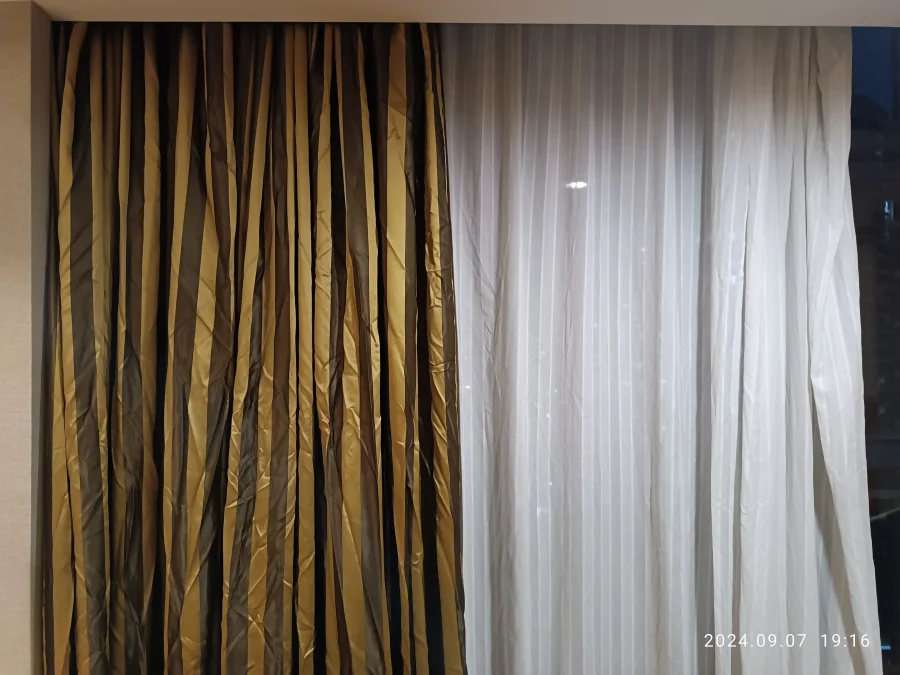
A single blackout gives you a binary choice: sunlight or darkness. In practice people pick darkness, live with the lights on, and lose the daylight they paid for the window to get. Adding a chiffon sheer in front creates the middle setting — light in the room, glare gone, privacy kept — and that is the setting most households use for most of the day.
The pairing also traps a layer of air between the two curtains, and that air pocket does real insulating work. Put your hand between a layered pair on a July afternoon and the difference in temperature between the glass side and the room side is obvious.
The fitting details that decide everything
- Run the track past the window. Extend it 15–20 cm onto the wall on each side. This lets the curtain stack completely clear of the glass when open, and closes off the light path when shut.
- Go from ceiling to floor. A curtain that starts at the top of the frame and stops at the sill leaves two open channels for light and heat. Ceiling-fixed and floor-length looks better and works better.
- Add a centre overlap. A pair of curtains meeting edge-to-edge leaves a vertical light line down the middle of the room at sunrise. An overlap arm on the track costs very little and removes it.
- Mind the heading. Eyelet and tab-top headings scallop away from the pole and let light in along the top. They are fine in a living room and wrong in a bedroom.
Colour, and the mistake with dark fabric
Dark colours absorb more heat than light ones. On a curtain that matters less than you would expect, because the heat is absorbed at the window and much of it re-radiates back out through the glass rather than into the room — provided there is an air gap. A dark blackout pressed flat against the glass in a tight reveal is a genuine radiator; the same fabric hung 10 cm clear of the window with air moving behind it is not. If you want dark curtains, hang them properly and they are fine.
Dust and the AC
Air conditioning moves a lot of air, and that air carries fine dust. Anything hanging in its path collects it. Sheer fabric shows it first and needs washing every three to four months; blackout hides it and needs vacuuming rather than washing. Plan for this at the point of choosing — a sheer you cannot easily take down is a sheer that will stay dirty.
What we would specify for a typical Dubai apartment
Bedrooms: chiffon sheer from catalogue 401 in front, plain blackout from 302 behind, on a ceiling-fixed double track running well past the glass, pinch pleat heading for a proper light seal. Living room: the same pairing, but with 301 textured or 303 jacquard for the blackout since it is a larger visual element in the room. Kitchen: skip the curtain, fit a sunscreen roller. Bathroom: a faux-wood venetian or a translucent roller.
None of that is exotic and none of it is expensive relative to the window it is covering. It is simply the combination that works in this climate, and it is what we end up recommending in most homes we visit.