Curtains for a Majlis and Very Wide Windows
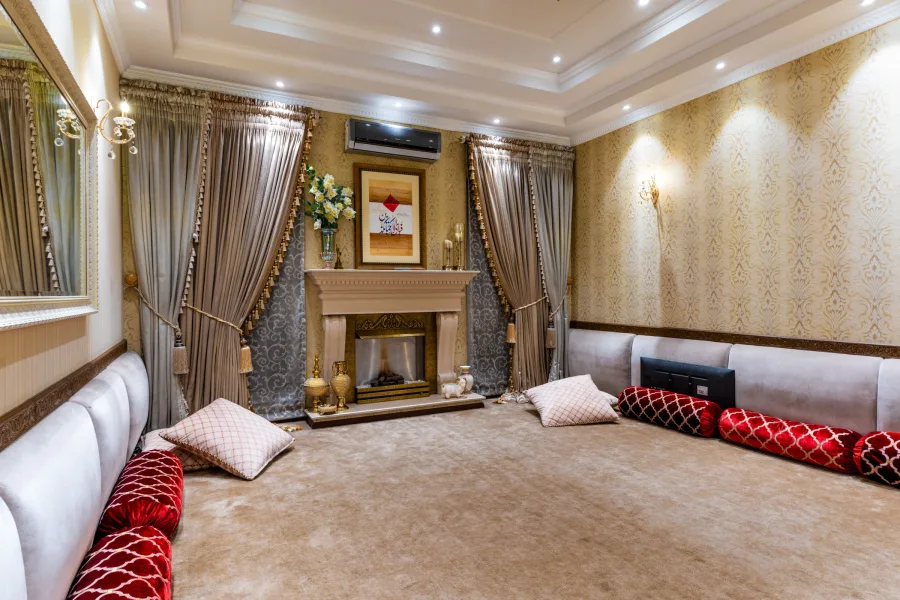
Majlis walls, villa glazing and open-plan living rooms in this market routinely run five, six, eight metres. Everything that is forgiving at two metres stops being forgiving at six. Here is what changes.
Stack-back is the decision people forget
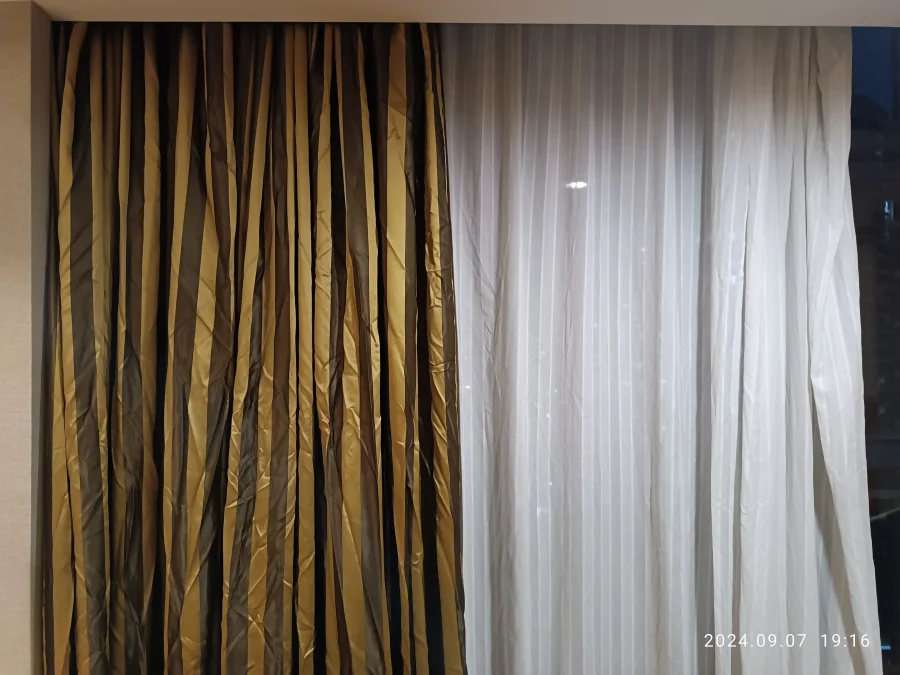
Open curtains do not disappear. They gather into a bundle at each end, and that bundle is roughly a fixed proportion of the fabric on the track — so on a long run it is a substantial block of cloth. On a wide window, that bundle sits across the glass unless the track has been carried past the opening on both sides.
The fix is straightforward if it is planned: run the track well beyond the reveal so the stack lands on the wall, not the view. It costs a little more track and it is the single biggest difference between a wide window that looks right and one that feels half-covered all day. Where there is no wall to stack onto — glazing that runs corner to corner — the honest answer is to accept a permanent soft edge of fabric, or to split the run.
Splitting: two panels, four, or a centre pair
- A centre pair is the default and the most formal. It suits a majlis wall with a symmetrical opening and looks correct when closed.
- Splitting into four panels on a long run gives you the option of closing only the half in the sun. In practice this is what people actually use day to day.
- A single panel drawing one way works for a corner or a door and keeps the whole stack out of the middle. It needs somewhere for that stack to go.
Decide this at the visit, in the room, with the sun where it will be. It is much harder to change afterwards than the fabric is.
Track joins are normal — the join should not be
Track comes in lengths. Any run longer than a single length is joined, and a properly made join is invisible to the hand: the gliders pass over it without a click and without catching. A bad join snags, and on a six-metre curtain you feel it every single time you draw it. This is a fitting-quality question rather than a product question, and it is worth asking any company how they handle it.
Long runs also want a ceiling-fixed track rather than a pole. A pole spanning six metres needs centre brackets, and a centre bracket is a hard stop the curtain cannot pass — which turns one wide curtain into two narrower ones whether you wanted that or not. Track versus pole goes into the trade-off; on wide openings it is not really a trade-off. See also the track range.
Weight, and what it does to the ceiling
Six metres of lined blackout is heavy. Two things follow. The track has to be fixed into something structural, which on a false ceiling means finding the framing or fixing above it — this is the check we make at the visit and the most common reason a wide-window job needs a different approach than the customer expected. And the drawing gets heavier: past a certain width, a cord set or motorisation stops being a luxury and becomes the thing that decides whether the curtains get used at all. On a majlis wall that guests see closed, it is also the difference between an even, dressed run and one that has been dragged by hand at one end.
Getting the folds even across a long run
Unevenness is the visual failure of wide curtains — the eye reads a rhythm across six metres and notices immediately when it breaks. Three things protect it: consistent fullness across every panel, a heading that spaces itself (wave is the most forgiving over distance, pinch pleat the most formal — see heading types), and dressing the folds at fitting so the fabric learns where to break. That last one takes twenty minutes and no company should skip it.
What it costs, roughly speaking
No figures here on purpose, but the shape is worth knowing: a wide window costs more or less in proportion to its width, not its area. Height changes the fabric drop, width multiplies the panels — the reasoning is in what drives the cost of curtains in Dubai. Put your own measurements into the price estimator for a number, or book a free home visit and we will measure the run, check the ceiling and tell you where the stack should sit.