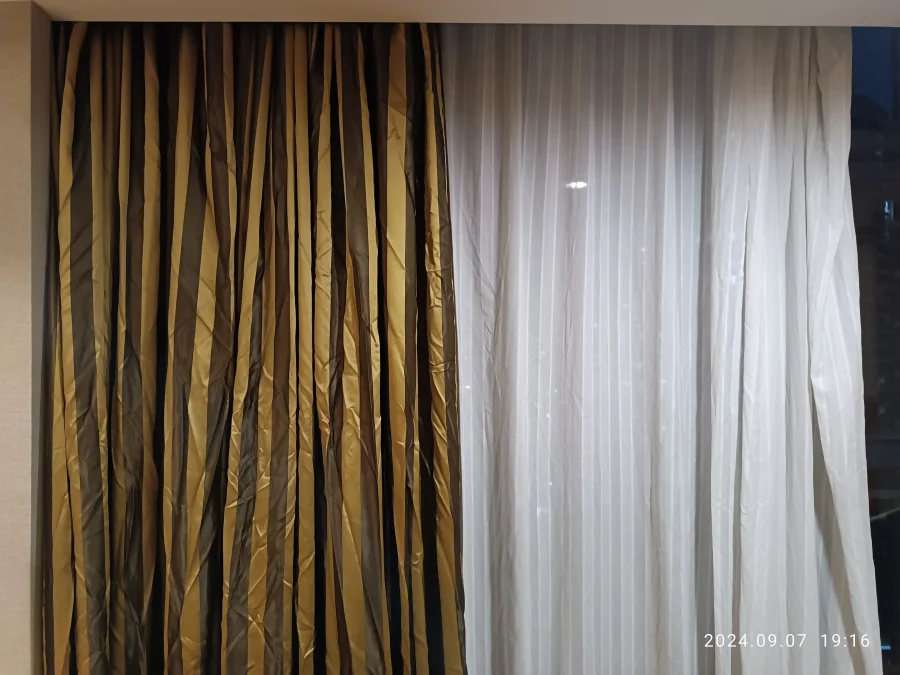
How Much Do Curtains Cost in Dubai?

This page deliberately does not print a price list. Rates move, fabrics come and go, and a number typed into an article is out of date the moment it changes — which is worse than no number at all, because you would have planned around it. What does not move is what you are paying for. Understand that and you can read any quotation in this market, ours included.
Width drives the cost, not height
This is the single most common surprise. People assume a tall window costs more than a wide one. It is usually the other way round. Curtains are made from fabric that comes off a roll 320cm wide, and that roll is hung so its width becomes your curtain's height. A window three metres tall still takes one drop of fabric per panel. A window twice as wide takes twice as many panels.
So when you compare two quotations, compare them per metre of track width. A quotation that prices "per window" is hiding the only measurement that matters.
Fullness: the multiplier nobody mentions
A curtain is never the width of its window. It is gathered, and the gather is what makes it look like a curtain instead of a bedsheet. That multiplier is called fullness, and it is the second biggest line in any quotation:
- 2.0x for a pinch pleat — the standard, deep folds, holds its shape.
- 2.2x for a chiffon sheer, because a thin fabric needs more gather to read as a curtain at all.
- 2.5x for a wave heading, which is the fullest and the most fabric.
A three-metre track at 2.5x fullness is buying seven and a half metres of cloth. At 2.0x it is six. That is the whole difference between two quotations that look identical on the surface. Which heading suits which window is the subject of our guide to curtain headings, and the maths is worked through in how much fabric curtains actually need.
Lining, or the second curtain you did not know you were buying
A blackout curtain is not a dark-coloured curtain. It is a fabric with an opaque backing, and in our books that backing is woven in rather than glued on. If you want a sheer for daytime privacy and something that darkens the room at night, you are buying two curtains on one window and a double track to carry them. That is a genuine doubling of the fabric cost, and it is the right choice in most bedrooms — see blackout or sheer for which rooms actually need both.
The track is not an afterthought
The track runs past the window on both sides so the curtain can stack off the glass, so you pay for more track than window. A double track costs more than a single. A ceiling-fixed track in a concrete slab is a different job from a rod on brackets. None of this is expensive on its own; all of it is left off cheap quotations, which is why cheap quotations grow. Our tracks and rails and curtain rods pages set out what goes where.
Fitting, and what "fitted" should mean
A fitted price should cover a person coming to the home, measuring, and hanging the finished curtain — including the fixings and making good. If a quotation separates "installation" into a figure you only see at the end, you are not comparing like with like. Ours is one number that covers fabric, track, tailoring and fitting, which is the whole point of our price promise.
What actually makes a quotation go up
- Very wide openings — sliding doors and villa majlis windows, because width is the driver.
- Layering — sheer plus blackout on a double track.
- Wave headings, at 2.5x fullness.
- Motorisation, which adds a tube motor and its power supply. Motorised curtains and blinds explains where it earns its keep.
- Difficult ceilings — a shallow bulkhead or an AC vent directly above the window changes the fixing, and that is a visit-day discovery.
Getting a real number
Two ways, both free. Put your own width and drop into the price estimator and it will compute a range from the same rates we quote from. Or book a free home visit and we bring the four Pak Home books to you, measure every window properly and leave one written figure. There is no charge for the visit and no deposit to book it, whether or not you go ahead.