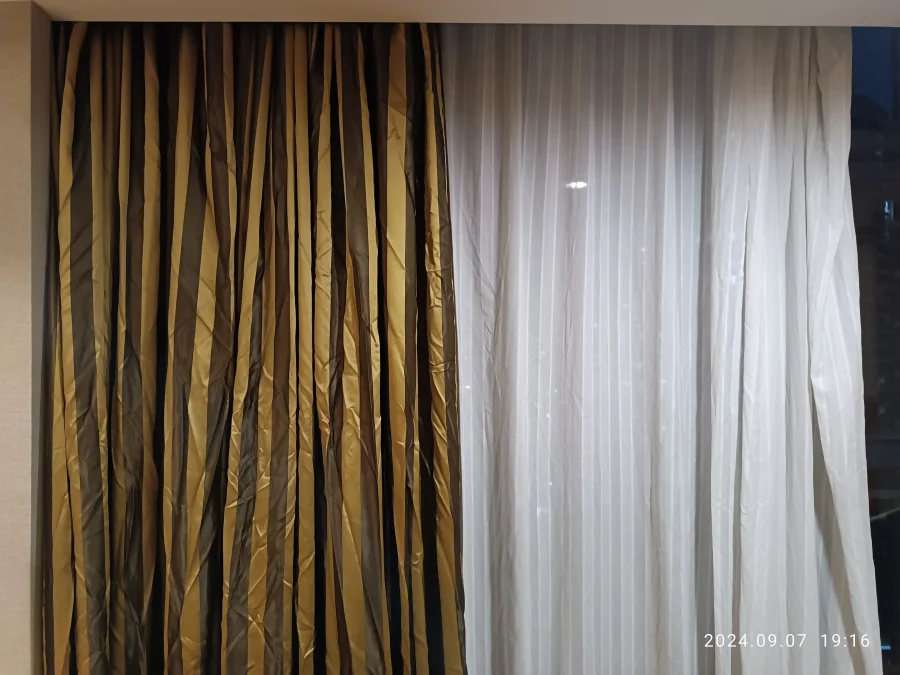
Lining, Dimout and Blackout: What the Words Mean

Walk into three curtain shops in this market and you will hear the same three words used to mean different things. It is worth ten minutes to get them straight, because the difference between them is the difference between a bedroom you can sleep in at eleven in the morning and one you cannot.
Lining is a second fabric, sewn to the back
A lining is a separate cloth attached behind the face fabric. The face fabric is the one you chose for its colour; the lining is chosen for what it does. It blocks some light, it protects the face fabric from the sun, it adds weight so the folds hang properly, and it hides the seams from the street. A lined curtain is thicker, heavier and hangs better than the same fabric unlined.
The important part for the UAE is the protection. The face fabric is the expensive layer and the sun is what destroys it — the lining takes that punishment first, which is most of what stops curtains fading.
Dimout means most of the light, not all of it
Dimout is a performance level, not a construction. A dimout fabric knocks the room down to a comfortable gloom: you can still tell it is daytime, you can still make out the shape of the window, you would not photograph in it. Sit in a dimout room at noon and there is a soft glow around the edges and a faint sense of the fabric being lit from behind.
That is the right answer for a lot of rooms. A living room does not want to be a cave. A child's room often wants dim rather than dark, because pitch black at nap time makes bedtime harder later. Dimout also holds its colour better in strong light than a very heavy blackout weave, because there is less of a coated back to break down.
Blackout means the fabric passes no light at all
A true blackout fabric is opaque. Hold it up to a window and you see the outline of the cloth and nothing through it. In a fitted curtain the fabric is not usually what lets light in — the gaps are. Light comes around the sides, over the top of the track and under the hem, and it will do that however good the cloth is.
Which is why blackout is as much a fitting question as a fabric question. Track fixed to the ceiling rather than the wall, the run carried well past the reveal on both sides, generous fullness so the folds close properly, and a hem that reaches the floor. Our blackout curtains are made that way as standard; the fabric on its own would not get you there.
So which do you actually need?
- Bedroom, west-facing, you sleep late or work nights. Blackout, ceiling track, generous overlap. Nothing else does it.
- Bedroom, you want to wake with the light but not be woken at five. Dimout, or blackout on a sheer that you leave closed — see the double-layer option.
- Living room, television on the far wall, glare is the complaint. Dimout, or a sheer alone if the glare is only at one time of day.
- Any room where the fabric is in direct afternoon sun. Lined, whatever the light level you want. This is a longevity decision, not a darkness one.
What about heat and noise?
Both improve, neither is solved. A lined blackout curtain across a glazed wall genuinely takes the edge off the radiant heat coming off the glass in the afternoon, and you will feel it standing near the window. It is not insulation and it will not fix a room the air conditioning cannot hold. On noise, heavy fabric absorbs the reflections inside the room, which makes the room sound softer, and does very little about a road outside. Anyone who tells you curtains soundproof a window is selling you something.
Seeing it before you commit
This is the part you cannot do from a screen. Dimout and blackout look identical folded on a table and completely different held against a window. When we come out we bring the physical books and hold the fabric against your own glass, in your own light, at whatever time of day you are worried about — book a free home visit, or work out the size of the job first with the price estimator.