Curtains, Humidity and Mould in the UAE

People arriving in the UAE expect sun damage and are surprised by damp. Coastal humidity in Dubai, Sharjah, Ajman and along the east coast regularly sits high enough that any cold surface collects water — and the coldest surface in the room is the glass the air conditioning is fighting. Whatever hangs against that glass is in the splash zone.
Where the water comes from
Warm humid air touches cool glass, gives up its moisture, and it runs down. That happens on the inside of your window, not the outside, and it happens most in the rooms you cool hardest. Add a kitchen or bathroom nearby, a drying rack, or a balcony door opened at the wrong time of day, and the fabric nearest the glass spends hours slightly damp.
Damp fabric with no moving air is where mould starts. It is almost never the curtain's fault and almost always the position's.
What it looks like before it is obvious
- A musty smell when you first draw them, strongest at the bottom third. This is the earliest signal and the easiest one to act on.
- Small dark speckles along the hem or the leading edge, often mistaken for dust. Dust brushes off; this does not.
- A stiff or slightly tacky feel low down on a lined curtain, where the lining has been repeatedly wetted and dried.
- Marks on the wall behind the stack, which usually means the curtain has been left closed against a cold wall for weeks.
The habits that prevent it
- Let air move behind the curtain. This does more than everything else combined. Curtains permanently closed against glass in a cooled room are the classic case. Open them daily, even briefly, even if you close them again immediately.
- Do not let the hem sit in water. If condensation pools on a sill, the hem should not be touching it. Sometimes the answer is a slightly different track position rather than a different curtain.
- Watch the room, not the fabric. A bedroom cooled hard overnight with the door shut is the highest-risk room in most apartments.
- Deal with the smell immediately. Musty is reversible. Speckled is a repair question and sometimes a replacement one.
Does the fabric choice help?
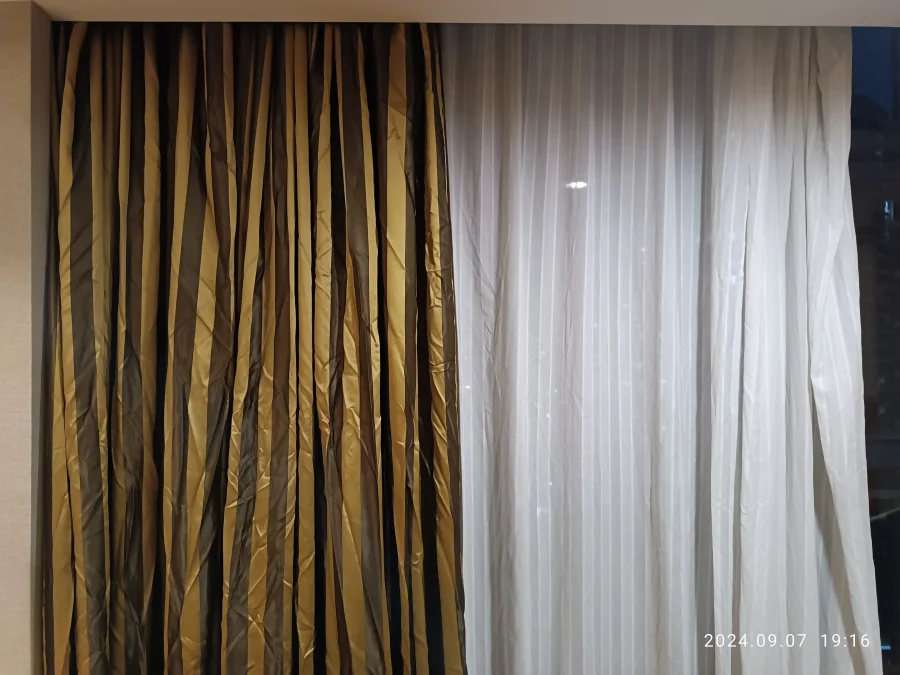
Somewhat, and less than the habits. Lighter, more open weaves dry faster and hold less water, which is part of why a chiffon sheer in the layer nearest the glass is a sensible arrangement in a humid room: the sheer takes the contact and the heavier blackout hangs further back where the air is warmer. That is the same double-track logic that works for sun protection, from the other direction.
Blinds are worth considering where the water problem is severe and permanent. A roller blind has far less fabric sitting against the glass than a gathered curtain does, and it dries in the open position. It is a different look, and in a wet reveal it is often the more practical answer.
Cleaning, carefully
Do not put a lined or blackout curtain in a washing machine hoping to kill mould — the lining and the fabric shrink at different rates and the panel comes back the wrong shape. Cleaning curtains in the UAE covers what is safe for each type. For a curtain that is only musty, the treatment is usually air and light rather than water.
If it has already happened
Be realistic: established mould in a lining is rarely worth saving, and a cleaned panel that still smells will smell again within weeks. The useful thing is to change what caused it at the same time as you replace the fabric — a different track position, a lighter layer against the glass, or a blind instead. Tell us about the damp at the visit rather than after; it changes what we recommend. Book a free home visit, or size the replacement first with the price estimator.